Saturday, 18 February 2017

Salsiccia e Fagioli (Italian Fennel Sausages with Borlotti beans)

Serving grilled pork sausages with Heinz beans is a common sight in the UK, particularly the morning after a night out, where you may pop a couple of slices of buttered toast for to soak up the residue alcohol from the night before.

Who would have thought the Italian also has their take on sausage and beans thou a little more refine and minus the tomato sauce (!!). I'm spoiled to have access to an Italian grocery nearby where they stock proper Italian fennel sausages (as well as other goodies); alternatively chipolata will do just fine. 

As per my previous post, Italian food is all about using simple but the best ingredients you can afford, even the extra virgin olive oil, get the best and most pure stuff you can lay your hands on. Trust me, it really does taste better. 

If you are planning to make this for breakfast at the weekend, don't think this can be made in 15 minutes - O.K. it is possible if you use tinned borlotti beans instead of the dry stuff. I guess my point is don't forget to soak the beans the night before!!


Serves 4

600g Italian fennel sausages (or chipolata) 
3 gloves of garlic, crushed
2 string of fresh thyme, finely chopped
A knob of butter
Extra virgin olive oil
300g dry borlotti beans, soak overnight in plenty of fresh water
1L beef stock

1. Preheat the oven grill to 180. Crush the garlic and thyme in a mortar and pestle, add in a generous dash of olive oil and mix well.

2. Rub the mixture all over the sausages and place them on to the oven grill pan. Let it grill for 20 - 25 minutes or and turn them over halfway. The idea is to cook until they are browned. 

3. Meanwhile, drain the soaked borlotti beans and place them in a large enough saucepan. Pour in the stock, place it on medium heat and bring it to boil then reduce to simmer for for 35 - 45 minutes. They need to be soft enough so they can be mashed easily using a potato masher. 

4. Once they are soft enough drain them but reserve 2 tbsp of the stock. Use a potato masher to crush them lightly so they are slightly broken. If it is looking a little dry, add in the reserved stock. Season with some salt & pepper.

5. Back to the sausages. Once they are cool enough to touch, cut them diagonally. Just before serving, mix in a knob of butter into the beans to give some gloss. Plate the beans and place the sausages on top.

Friday, 17 February 2017

Risotto ai Funghi (Mushroom Risotto)

Only if I could get my hands on some fresh porcini then I would have named this dish "Risotto ai Porcini" instead. Instead I resulted in using Sainsbury's British Speciality Mushrooms, which consist of shiitake, oyster mushroom, eryngii & maitake - well that's what was in my punnet and I believe they all vary slightly. 

However, instead of using bog-standard vegetable/ chicken stock cube I actually invested in some porcini stock cube from my local Italian grocery shop. Whenever I step into that shop its like a kid has gone into a sweet shop. I love to look at everything they have on the shelves, and regardless what I went in for, I always walk out with some truffle mortadella. I will have to dedicate a post on it soon... it is absolutely delectable! 


So let's get back to the risotto... True to most Italian cooking, I kept it very simple.

Serves 2

160g arborio rice
20g dried porcini, soak in hot water for 20 minutes before use
1 porcini stock cube (if you can't find them I would suggest soaking the dried porcini with some extra of water)
1 small onion, finely chopped
2 cloves of garlic, sliced
1 large glass of white wine
3 dollop of butter
200g of speciality mushrooms, cut into bit size
Freshly grated Parmesan cheese.

1. Soak the dried porcini mushroom in hotel water.

2. Finely chopped the onion; sliced the garlic cloves; dilute the stock cube with boiling water and cut the speciality mushrooms into bite size.

3. Place a frying pan on medium heat, add a dollop of butter, wait for it to melt and sizzle.

4. Add the garlic, cook until lightly brown before adding the speciality mushrooms. The idea is not to cook the mushroom thoroughly but to add some colour and garlic flavour to them. Also be careful they are not overcooked (become watery). Set them aside. 

5. Place a deep casserole dish (I used B size Le Creuset) over medium heat, add the other dollop of butter, wait for it to melt and sizzle then add in the onion. Cook until lightly brown before adding the arborio rice. Make sure the onion mixes well with the rice.

6. Pour in the white wine, stir the rice until the wine is evaporated. Add in the rehydrated porcini and the soaking water. Keep staring. 

7. When the water is nearly evaporated, gradually pour in the stock and keep staring. Add more stock when the rice is looking dry. Repeat this until the rice is cooked to al dente. 

8. When the rice is almost cooked, reheat the fresh mushrooms in the frying pan. Season with some salt & pepper. 

9. Add in a handful of grated Parmesan cheese to the rice and mix well.

10. Just before serving, add the last dollop of butter and mix well. This is to give the rice a bit of shine.

11. Serve up the rice and place the fresh mushrooms on top, then sprinkle with more Parmesan. 

Saturday, 11 February 2017

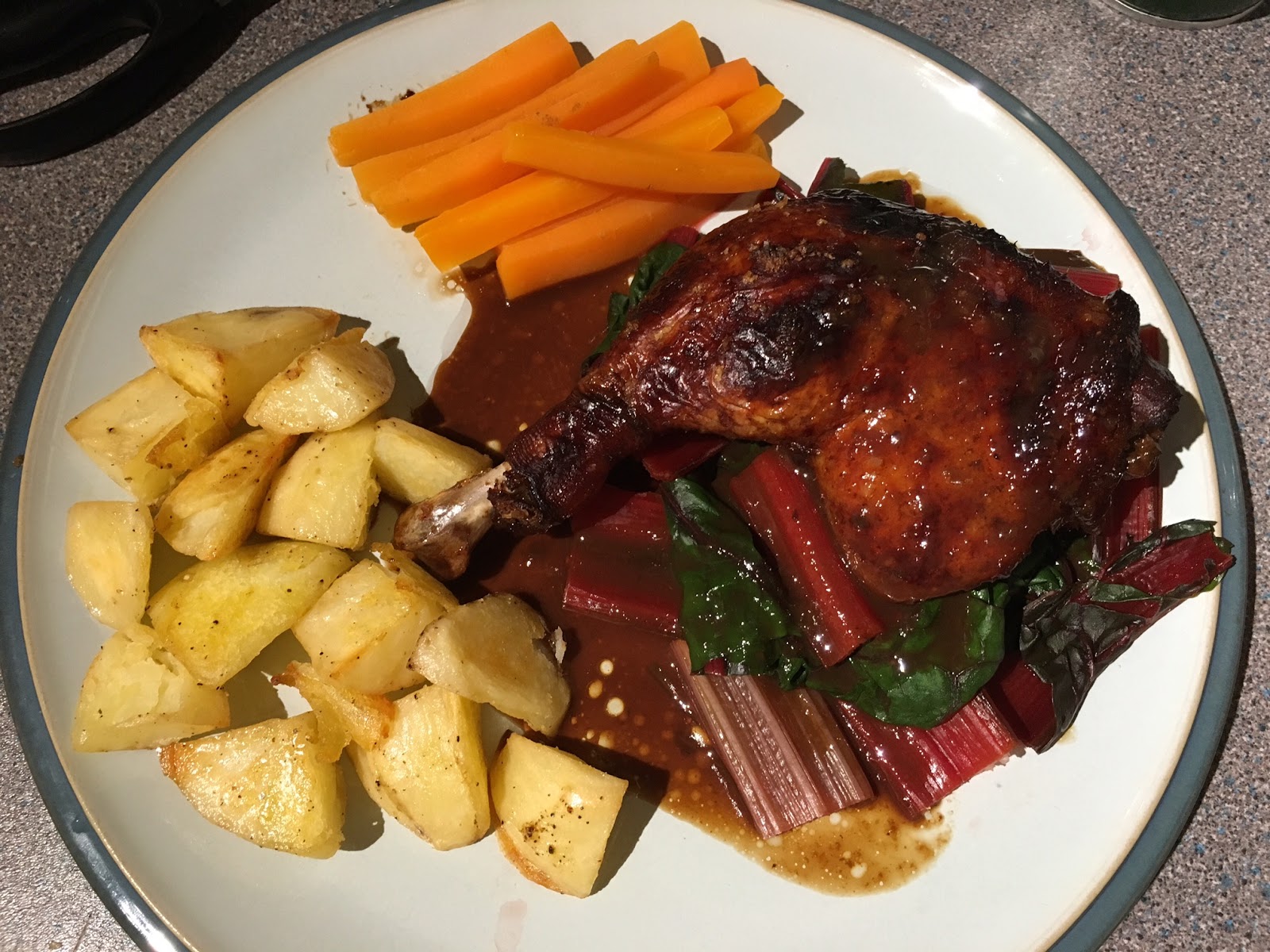
Gressingham duck legs marinated in homemade plum sauce

I haven't had the luxury of time to forage for berries in the wild last year, also the community orchard nearby has been stripped bare by some greedy leeches in the early seasons, so no apples or plums either. Indeed this is very disappointing as my pantry collection requires urgent replenishing!

I recently put my last bottle of plum sauce into use, and just realised I did not write a post on making plum sauce! I gathered over 6kg worth of plums last year and made A LOT of plum sauce. They taste even better after being left on the shelves for a year.

The end result is Gressingham duck legs marinated in plum sauce overnight, grilled and serving with steamed chard, carrots and roast diced potatoes. If I may say so the combination was gorgeous. The earthiness of the chard balanced the sweetness of the plum sauce, which also has a hint of sharpness! 


Serves 2

2 Gressingham duck legs (or duck breasts if preferred) 
2 maris piper potatoes, diced
1 bundle of red Swiss chard, separate the leafs and the stems
250ml of plum sauce 
Dollop of organic unsalted butter

1. Place the duck legs in a freezer bag and pour in the plum sauce then securely seal it. Make sure the legs are coated with plum sauce all over. Leave in the fridge overnight. 

2. The next day, peel and dice the potatoes, as well as peel and prepare the carrots. You may prefer leaving the skin on which is also fine.

3. Preheat the oven to 180°C. 

4. Place a frying pan over medium heat. When it is hot enough add a dollop of butter, wait for it to sizzle then place the duck legs on skin down and cook for 8 - 10 minutes until brown.

5. Transfer the duck legs into a baking tray and carefully pour in the plum sauce so it doesn't touch the skin. Sprinkle a generous amount of sea salt on top.

6. Put the diced potatoes into a separate baking tray, season with salt & pepper and a generous amount of oil. Massage them and place both the duck legs & potatoes into the oven, with the duck legs on the higher shelve. 

7. Cook in the oven for an hour or so. It is OK to have duck a little pink in the middle and that's how I have mine, so feel free to adjust the timing in accordance to your taste. 

8. Make sure the potatoes are periodically tossed and turned so they don't become stuck to the tray.

9. Around 20 minutes before the duck legs are ready, boil the kettle and place the carrots & stem of swiss chard into the steamer and steam for 15 minutes or until soften. Add in the swiss chard leaves and steam for further 5 minutes.

10. Plate up the duck legs, diced potatoes and vegetables. Before ordaining the dish with the plum sauce juice, you may wish to spoon out as much of the duck fat as possible.


Thursday, 15 December 2016

The Classic Milano Panettone

Christmas is only round the corner (again), how time flies... Being a childless adult with no responsibilities, apart from the food and an excuse to have lots of gatherings, I am indifferent about the festive period. Lots of people generally putting so much emphasis on the whole thing, the pressure of having a good time is such an anticlimax. 

For most workers we can effectively have 10 days off work - the perfect length for a holiday somewhere away from the frenzy, and that's precisely what I am doing, jetting off to soak up some winter sun and top up my Vitamin D. Before we jet off, there are guests to be entertained, food to be made and consumed!!

I do enjoy good quality mince pies, especially there freshly baked ones by a local baker. That said, i am not a fan of Christmas pudding or Christmas cake. In the same boat and struggle to think of something Christmasy to serve your guests as pudding? Well, the Italian panettone could be your saviour. This sweet bread loaf/cake originates from Milan, and you will be amazed how much tastier to make your own. 

Because it is a bread/ cake loaf, the preparation time is rather long. If you are thinking of making some at night to take into the office in the morning, I would recommend allow 2 days for this process. If you are preparing this in the morning for a evening meal then that should allow enough time. 

Instead of getting a special panettone tin I used a muffin instead. I also think it is nice to serve mini one.

 1st batch
2nd batch
Wrapped a couple up as gift

Make 6 (muffin size)

250g good quality plain flour
250g Italian 00 grade flour
200g caster sugar
160g good quality butter
12g easy bake yeast
4 large free range eggs
3 free range egg yolks
150g sultanas
80g Waitrose Italian cut mixed candied peels
Zest of 1 lemon
15ml pure vanilla bean paste
A splash of milk and warm water
A shot of brandy

1. Combined the 2 flour and put them trough a sieve.

2. Measure the sultanas and soak them with a shot of brandy mixed some warm water. Leave to one side.

3. In a small bowl, dissolve the yeast with a splash of milk mixed with warm water. 

4. Mix in 75g of the combined flour, knead until smooth then shape into a ball. Slash the dough with a cross over the surface and place into a bowl, cover with clingfilm and leave it to rise in a warm place. This should take approximately 45 minutes.

5. When the dough has doubled in size, add an addition 250g flour and 2 eggs. Knead until smooth. 

6. Add 100g of sugar and knead until the sugar is mixed into the dough completely. Add 60g of butter and knead again until it is well combined. Again, leave it to rise in a bowl covered with cling film in a warm place. The dough should double in size in an hour or two.

7. Once risen, Add 2 eggs, 3egg yolks and the remaining flour into the bowl and knead until smooth. Add in the remaining sugar and knead until the sugar is mixed into the dough completely. Add the remaining butter and knead again until it is well combined. 

8. Mix in the sultanas, lemon zest, candid peels and vanilla bean paste. Mix for 5 minutes and again leave it to rise in a bowl covered with cling film in a warm place for another 2 or 3 hours.

9. Meanwhile, oil the muffin tin and line it with muffin casing or greaseproof paper. Preheat the oven at 200°C. 

10. Carefully transfer the dough mix into each mould. Let it for 5 minutes or so for it to rise a bit further before baking.

11. Place a small bowl of water in the oven before place the muffins onto the lower shelve of the oven. Bake of 5 minutes, take them out and slash a cross on the surface of each panettone (this is to stop them expanding into muffin tops in the heat), place a dab of butter int he middle of the intersection of each, return to the office and cook for further 10 minutes before reducing the heat to 180°C and cook for 30 - 45 minutes, depending on the ovens' power and efficiency.

12. To test if the panettone is cooked, put a skewer all the way though in the middle. If it comes out clean and not sticky then it is ready.

Merry Christmas!


Thursday, 10 November 2016

Boiled Dumplings (水餃) with Szechuan Red Oil Sauce

Dumplings are one of my favourite food. Pan fry, boiled, steamed, deep fry.... I love all forms of dumplings and can never have enough of them. Making them is not difficult at all, especially if using pre-made wrappers. All that is required is to chop some vegetables. marinade the meat and let the wrapping commence. 

Making your own wrapper is an entirely different story. My partner and I learned how to make dumplings from scratch and they really do taste different. The wrapper has more textured, or perhaps they taste better because it usually takes over 2 hours just to make a just a dozen... 

Wherever possible we would purchase free range belly pork at the butcher and has it minced fresh. The result is quite remarkable. Pre-minced meat usually is more watery which dampen the wrapper so they don't keep the shape as well. More importantly there is a different in taste and quality. I would recommend giving this a go.

The veg that goes in the dumplings is usually Chinese chives, which is widely available in Asian supermarkets and has a distinctive garlicky taste to it. Alternatively pak choi or cabbage is just as good although lacking the garlicky flavour. 

Now the marinade. The meat is usually marinaded in light soy, sesame oil, ground white pepper,  chicken powder and Shaoxing wine. Mix all the ingredients together until the meat becomes a little sticky before mixing in the Chinese chives or any kind of vegetable of your choice. 

Here are the 3 different ones I've made recently. The sauce that goes on top is Szechuan Red Oil Sauce. I don't always follow the exact recipe, especially the coriander bit as it doesn't always make it on to the shopping list!


Szechuan Red Oil Sauce

First you need to make some infused dark soy sauce:

100ml dark soy
100ml water
1 tsp of sugar
1 tsp of ground cumin
1 star anise 
2 cloves
1 cinnamon stick
1 tbsp of Shaoxing wine

1. Place everything but Shaoxing wine in the frying pan and bring to boil then let it cook on low heat for 10 minutes. 

2. Take it off the heat and mix in the Shaoxing wine.

Now the Szechuan Red Oil Sauce:

1 tbsp Szechuan pepper oil
1 tbsp of chilli oil (add more or less depending on personal taste)
1 tbsp of fresh coriander, chopped
1 tbsp of spring onion, chopped
1 tsp of sesame oil
2 tbsp of the infused dark soy sauce (as above)

1. Mix all everything but the spring onion and coriander together.

2. Add the spring onion and coriander just before serving.

3. Pour over the dumplings and enjoy.


Thursday, 20 October 2016

Homemade Hummus Dip

One of my life goal for this year is to get fitter, and I am aiming to achieve this through exercise and better eating habit. I don't eat badly but I can eat better. My weakness is crisps, or strictly peaking anything snacks that are crunchy and savoury! 

I am trying to cut down/ out of this bad habit, and replace it with something healthier, hummus dip. OK, shop bought hummus dip is not that fantastic, I mean check out that traffic light labelling on the front. Hummus dip is extremely simple to make, and the key tool to success is a mini food chopper. 

I would like to say that after many trial and error I may have finally mastered the best hummus dip, in terms of consistency and flavour! 


400g of chickpeas in water
80ml of rapeseed oil
1 1/2 tsp of salt
1 juice of lemon
2 cloves of garlic
2 1/2 tbsp of tahini paste
A sprinkle of paprika 

1. Rinse the chickpeas under cold tap water and drained.

2. Place all the ingredients in to the mini food chopper and blitz until smooth.

3. Scoop hummus into a glass bowl or any container you wish to use and sprinkle with paprika.

Great with carrot or celery sticks. For something crunchy, serve with wholegrain crackers.

Sunday, 25 September 2016

Beef congee (牛肉粥)

Congee is especially comforting and cleansing when I feel under the weather or when overindulge. There are so many kind of congee, chicken, fish, pork, beef or better still, plain ones. The congee recipe remain largely the same but mix in with different ingredient.


Serves 2

180g of rice
150g minced beef
1/2 cube of organic chicken stock cube
Dash of sesame oil
1.2L water
1 tbsp of mirin
Pinch of white pepper

1. Season the rice with a pinch of salt and a dash of sesame oil. Soak in cold water for at least a couple of hours before cooking (preferably overnight as this process helps to breakdown the rice).

2. Bring the water to boil, stir in the rice. Turn the heat up and keep staring for 5 minutes.

3. Bring the heat down, cover and let it simmer for 20 minutes.

4. Meanwhile, marinate minced beef with mirin, salt & white pepper.

5. Back to the congee base. Turn the heat up, break up the chicken stock cube and add, stir for 10 minutes. This is a very important step as it helps to break up the rice. If the consistency becomes too think, add some boiling water to dilute.

6. Take the congee base off the heat, stir in the minced beef, keep staring and break up the lumps.

7. Season with salt and white pepper to taste. 

Classic Carbonara

The typical carbonara that are available at high street eateries are usually laden with béchamel sauce. The cheesier it is, the better, and that's we define a 'good' carbonara. I am sure most Italian who come across these ghastly concortion of which we christianed carbonara would fell off their chair. 

An authentic carbonara is a very simple and light pasta dish, consist of pancetta, pasta and and egg to garnish. Here is my take on this classic. In this recipe I used macaroni pasta for no particular reason, apart from I have some left over from macaroni cheese. 


Serves 2

150g high welfare smoked pancetta
1 small red onion, finely chopped
2 cloves of garlic, crushed
150g closed cup mushrooms, sliced
1 small free range egg, whisked
160g macaroni, cooked in accordance to instructions on packet

1. In a deep frying pan, up some rapeseed oil in medium heat and cook the pancetta till they are starting to turn crispy.

2. Add the garlic and onion. Cook till soften.

3. Meanwhile, cook your pasta of choice in accordance to the instructions on the packet.

4. Add the mushroom and cook for a couple of minutes. Be careful not to overcook the mushrooms or they will go watery and grey.

5. Drain the cooked pasta and stir in with the pancetta mix.

6. Season with salt & pepper.

7. Take it off the heat and mix in with whisked egg. Be sure to keep folding the pasta mixture whilst adding the egg.

Enjoy!

Monday, 12 September 2016

Slow-braised beef tendon & beef shin in chu hou sauce (柱侯蘿蔔炆牛筋牛腱)

Early autumn is definitely in the atmosphere. There is a slight breeze when the wind blows and length of daylight is reducing for sure. It is again time for a change of our diet, and to opt for something more warming and comforting. 

I have decided to make one of my all-time favourite dishes this weekend: slow-braised beef tendon & beef shin in chu hou sauce. The combination of the tender beef shin, the nourishing texture of the tendons mixed with the flavoursome and versatile chu hou sauce is truly inviting. 


450g beef tendon
300g beef shin
300g mooli, thickly sliced 
200g chu hou sauce
4 tbsp of Shaoxing wine
500ml of boiling water
3 cloves of garlic, crushed 
1/2 tbsp of palm sugar
1 1/2 tbsp of dark soy sauce
1 1/2 tbsp of light soy sauce
2 piece of dried citric peel
1 star anise 

1. Boil a kettle full of water, blanch the beef tendon & shin and drained. 

2. Heat a tbsp of oil in casserole dish, add the garlic and cook for 1 minute. Add the chu hou sauce, both soy sauce and cook until the aroma is released. 

3. Pour in the water, bring the mixture to boil and add the dried citric peel, palm sugar & star anise.

4. Add the tendon & shin, cover and bring to boil then reduce to low heat and cook for 1 hour.

5. Add the mooli and cook for further 30 minutes or until tender. 

6. Serve with steamed rice and vegetables.

Note: It tastes even better the next day! 

Monday, 22 February 2016

Cream of mushroom soup (with crispy bacon)

Fungus is a fascinating ingredients. Depending on the variety, the texture is often vary. I would love to know more about fungus, or at least feel competent enough to forage these beauty in the woods. The only fungus foraging I have done is for Chicken Of the Wood. 


It is distinctively bright yellow and it was a well known local site. As the name suggests, this fungus has a texture of chicken meat and would make a fantastic substitute, only if it were commercially available. Simply pan fry it with a little oil, salt and pepper and that's all it was needed.

So that's a little insight into my love for fungus, back to this cream of mushroom soup recipe I originally wanted to share here. It is incredibly simple to make, and its great to take into the office for lunch or as a light supper. I sprinkled my with some crispy streaky bacon but they can be replaced with croutons if desired.  


Serves 4

900g chestnut mushroom, halves
1 tsp of thyme 
2 cloves of garlic, finely chopped
170ml single cream
1 potato, peeled and diced
1 litre of vegetable or free range chicken stock
1 tbsp of porcini paste
10g of dried porcini 
8 rashes of streaky bacon, diced

1. Preheat the oven to 150°C. On a baking tray, lined it with a sheet of baking paper, place the mushrooms on top and sprinkle the thyme and a drizzle some olive oil all over. 

2. Cook in the oven for 20 minutes. The mushrooms will shrink and release water. 

3. Take the mushroom out and sprinkle the finely chopped garlic. Cook in the oven for a further 10 minutes.

4. Meanwhile, cook the diced potato in the stock, dried porcini and porcini paste until very soft. 

5. In a frying pan, cook the bacon pieces until crispy.

6. Tip the mushrooms and the juices in with the potato and stock, bring it to boil.

7. Take the mixture off the heat and blend with a handheld blender. 

8. Mix in the single cream and sprinkle the bacon before serving.


Sunday, 21 February 2016

Szechuan 'Mala' Chicken (麻辣雞)

I love spicy food. The spiciness often helps to lift a dish up with a nice kick. Szechuan is renowned for its spicy food with an unique twist - spicy & numbing. A typical Szechuanese dish must consist chilli and a form of Szechuan pepper, this could be peppercorns, pepper oil, pepper powder etc Chilli gives the spiciness and Szechuan pepper gives the numbing/ tinkling sensation to the tongue and lips. If you have never experienced the tinkling sensation in the mouth whilst eating I would highly recommend trying this 'mala' chicken dish.

'Mala' literally means 'numbness and spiciness' and it usually used to described a cooking paste, which can be bought in most Asian supermarket. I made my own paste in this recipe and it is actually very straightforward. It can be kept in the fridge for a few weeks and it is fabulous for noodle dishes. In this recipe I will also share a tip in how to make sure the chicken stays succulent. 


Mala Paste 

This paste is of moderate heat. Please adjust the portion of spices in accordance to personal taste.

20 g fragmented black beans
30g chili bean paste
30g garlic
1 tsp ground cumin
1 tsp ground sand ginger powder 
1 tsp ground chilli powder
1 stp ground cinnamon
2 tbsp of Szechuan peppercorns 
1 tbsp sugar
1 tsp of salt
100ml water
A dollop of mayonnaise 

1. Lightly toast the Szechuan peppercorns on a frying pan then crushed using a pestle and mortal.

2.  In a bowl, mix in all the ground spices including Szechuan pepper powder and add the water. Mix well. 

3. In a mini food chopper, put in the garlic, fragmented black bean and chilli bean paste and blitz until smooth.

4. In a frying pan, squirt a dollop of mayonnaise and add a splash of oil. Heat until the mayonnaise dissolved. 

5. Now add the garlic & black bean paste into the frying pan and cook for 8 minutes on a low heat. You will need to keep folding the paste so it doesn't stick or become overcook. 

6. Pour in the spice powder water and fold in the 2 mixtures, follow by the sugar.

7. Cook the paste for a further 5 minutes and take it off the heat. 

Szechuan 'Mala' Chicken

Serves 4

1kg skinless free range chicken legs and thighs 
6 slices of fresh ginger
1 chilli, halves
2 garlic
5 stalks of spring onions 
3 shallots, halves
1 tbsp of Shaoxing wine
3 tbsp of mala paste

1. In a shallow frying pan, heat some oil and add in the shallots, half of the spring onions, chilli, garlic and ginger. Cook for a few minutes so the aroma releases into the air.

2. Add in the chicken and cook until they're lightly golden on both sides. 

3. Pour in the Shaoxing wine and follow by the mala paste made earlier (can be shop bought if preferred). 

4. Smother the chicken with the paste. Bring it all to boil, put the lid on, reduce the heat and let it simmer for 8 minutes.

5. Turn the heat off, leave the lid on and let the remaining heat to steam the chicken for a further 8 minutes.

6. Now, cook the chicken with high heat for 2 minutes before serving. 

Fantastic with rice and some veg. The mala paste should allow another serving, so perhaps try it with some minced pork next and serve it with noodles as a quick, mid week supper.


Friday, 11 December 2015

Simply Nigella's Asian-flavoured Beef Short Ribs (with a twist)

I love watching most cookery programmes and there are a few chefs I idolised, with Nigella Lawson being one of them. I have been religiously following her latest series on BBC and there are lots of excellent new recipes I am interested in trying out.

So, with so many recipes to choose from, where do I start? I had a family gathering last week and what a great excuse to try out the Asian beef short ribs. So effortless and can be pre-cooked the night before! 

Waitrose sells some delicious Aberdeen Angus beef short ribs at £6.99 per kg which I was tempted in purchasing; in the end I opted for what the local butcher has to offer instead. They were some well-hung beef from Twyford and just the look of them I know they will come out gorgeously delicious. This is a rack of ribs rather than short rib pieces. I've been reassured by the butcher that it cooks better this way. If you haven't got a big enough roasting tray/ pot then it cut up pieces will do just fine.


As the title of this post suggest, the recipe originates from the Simply Nigella series and I would not pretend otherwise. However, I did make some small adjustment to it. The key ingredient to the recipe is hoisin sauce. It is so easy to get all kinds of what used to be exotic ingredients in general supermarket nowadays it really does make life easier. The one I have gone for is the trusted Lee Kum Kee Hoisin Sauce. 'Hoisin' actually means 'seafood'. However, turn the jar around to the ingredients list you will see there is no sign of any sea creatures but mostly made up of fermented bean paste! I do love languages. 

Here is the finished masterpiece and my God it was divine! 


Serves 6 - 8

2.6kg beef ribs
1 jar of Lee Kum Kee Hoisin sauce
500ml water 
1 tbsp of light soy
1 tsp of dark soy
1 tsp of sesame oil
125ml of Shaoxing wine (or dry sherry as an alternative)
1 pinch of ground white pepper
1 tbsp of Chinese five spice
4 gloves of garlic, crushed
10 whole dried chillies, chopped
Some freshly ground Sichuan peppercorn 
1 bunch of fresh coriander, chopped
2 fresh red chilli, chopped (or use 1 tbsp of crushed dried chilli flakes) 

1. Preheat the oven to 150C/ gas mark 2. 

2. Place the ribs in a large, deep roasting tin.

3. Mix together all the above mentioned ingredients (apart from coriander & fresh red chilli) and pour over the ribs.  


4. Cover the roasting tin with foil, ensure the edges are securely sealed and place in the oven for 4 hours.

5. Once cooked, take the roasting tin out and leave on the side to cool. 

6. Transfer into a large tupperware or any type of container then leave in the fridge overnight. This is so the flavour can enhance and the fat solidify to the top.

7.  Before reheating the meat, remove the harden fat at the top and transfer the content into a ceramic ovenproof dish and cove with foil (I used the largest Le Creuset stoneware dish here).

8. Preheat the oven to 200C/ mark 6 and cook for 1 hour.

9. Scatter the chopped coriander & chilli on top before serving.

For the dinner, I served the meat with steamed rice and spinach. Much to my surprise here were leftover for lunch the next day. The sauce was so intensely rich I cannot resist to make a noodle soup dish out of this. The next morning I reheated the meat in the oven and boil some udon in just boiling water. When the meat and udon are ready, I dish up the udon with piece of meat sitting on top. I then anoint the dish with 2 tablespoon of the meat juice follow by the udon water. Boy oh boy it surely made a tasty noodle soup broth, and a lighter way of serving this beautiful dish too.

Wednesday, 2 December 2015

Chicken Wings with Potatoes (薯仔雞翼)

There is an old saying: 'The closer to the bone, the sweeter the meat'. I've been converted to that belief ever since I was a child, and it stems from my mother. She taught me how to eat a boney fish without chocking; tackle spareribs so all the meat comes off the bone and enjoy chicken wings. I love chicken wings and I consumed a lot of them when I was a child. Since I became more aware of animal welfare I now only consumed high welfare chicken wings, and Waitrose Duchy Organic Free Range Chicken Wings are like godsend. They are so meaty and flavoursome, I only wish other supermarkets would follow suit.

This is a very simple dish, and the key is to let the chicken wings marinade for long enough. 


Serves 2

Waitrose Duchy Free Range Chicken Wings 800g
2 potatoes, peeled and diced
1 tsp of palm sugar
1 thumb of ginger, thinly sliced
2 garlic cloves, crushed
1 tbsp of light soy
1 tsp of dark soy
Pinch of sugar
Pinch of ground white pepper
1 tsp of sesame oil
1 tbsp Shaoxing wine
1 tsp of oyster sauce
1 tsp of corn flour

1. Marinate the chicken wings with both soy sauce, sugar, white pepper and sesame oil for a few hours or overnight.

2. Prepare the potatoes.

3. Heat up some oil and fry the ginger and garlic until browned.

4. Brown the chicken wings on both sides and add a splash of Shaoxing wine.

5. Add the diced potatoes. Dissolve the corn flour with some cold water and a splash of light soy, pour in with the chicken and diced potatoes. Add in the palm sugar.

6. Cover the meat and potatoes with just enough water and bring it to boil. Reduce the heat and let it simmer for 20 minutes or until the potatoes are cooked through.

7. Serve with steamed rice and vegetables of your choice.

Sunday, 1 November 2015

Wild Mallard Breast Fillets with Spanish Croquettes

The clock has gone back over the weekend and autumn has officially creeped in. There is definitely a chill in the air, and it is already dark when we step foot out of the office. Autumn is my favourite season. The countryside turns golden and the crips, chill air is rather refreshing to the lungs. 

Despite all that, there is a lot of positives for autumn and winter. It is time to blow the cobweb off one's cast iron casserole dish, and look out for a variety of game available soon.

Duck is the most common game and is widely available all year round. It is my prefer game bird as it has a less intense flavour than the others. I came across these wild mallard breast fillets from Waitrose and they look divine.


I decided to keep my dinner simple and cooked the millard fillets the simplest way.


Serves 2

1 packet of wild mallard breast fillets (or normal duck breasts if they are not available).
1 red pepper, sliced
300g baby spinach, steamed
150g Sol & Mar Caprichos ibericos (from Lidl)

1. Cook the caprichos ibericos as per instructions on the packet.

2. Melt a knob of butter i a frying pan and sealed the mallard breast fillets until brown. 

3. Preheat the grill to 180 degree and place the fillets skin side up for approximately 10 minutes depending on how you like them. I prefer mine medium rare.

4. In the same frying pan, stir fry the sliced pepper until cooked through.

5. Steam the spinach on a steamer until they are wilted.

Serve! 

Tuesday, 27 October 2015

Homemade Rosehip Syrup & Rosehip Facial Oil

Have you ever notice these vibrantly red, fruit of the wild rose bushes? They are plentiful in the English countryside and it is a super wild food for immune systems as well as for youthful skin! Rosehip is a great source of vitamin C, 20 times the amount of vitamin C in oranges. To keep the nation health, during the austerity of the WWII, the British government encouraged the public to gather rosehips. They were then collected and processed into rosehip syrup by the Ministry of Food and were sold to the public at a discounted price in Welfare Clinics.

Rosehip syrup has an unique and delicate flavour. It can be enjoyed as a cordial, spooned over pudding or ice cream.

Today our high street is full of various vitamin supplements and those who uses rosehip syrup as vitamin C supplement is rare. However, another form of rosehip product has become immensely popular in recent years - rosehip oil. Apparently it is the best kept secret of many celebrities to keep their skin youthful and hydrated. There is a huge selection of branded rosehip oil available on the high street. I am sure they are as pure as they claimed to be but surely nothing is better for the skin than products made by your own fair hands?

This autumn I've been busy harvesting rosehips in the country to make my own rosehip syrup to fight off the cold/ flu, and the best rosehip oil to keep my skin looking youthful. They are a bit of a bugger to gather as we all know, rose bush is very thorny so considered you are warned!


Rosehip Syrup

Make approximately 1L

1kg rosehips
250g white granulated sugar

1. Clean the rosehip under cold tap water.

2. Bring 1.5L water to the boil in a preserving pan.

3. Mince the rosehips in a food chopper and transfer into the boiling water.


4. Bring to boil and allow to stand for 15 minutes before pouring the mixture through a muslin cloth, and allow it to drip until most of the liquid has come through. Reserve the pulp.

5. In the cleaned preserving pan, bring 750ml fresh cold water to the boil. Stir in the reserved pulp and repeat step 4 but discard the pulp in the end.
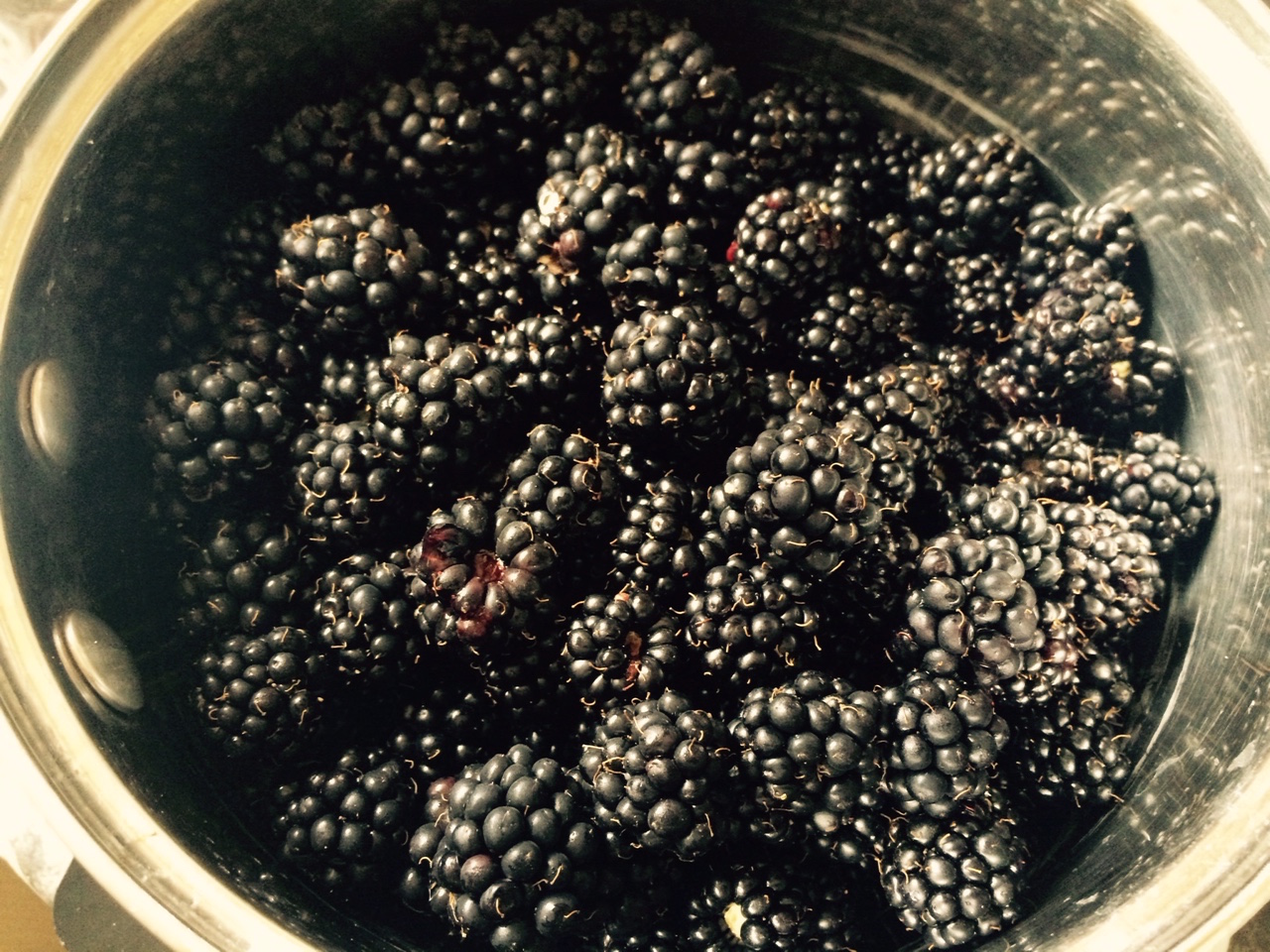
6. Combine the 2 solutions to the cleaned preserving pan and boil to reduce the liquid at around 1 litre.

7. Add the sugar and boil for a further 5 minute so it dissolve well.

8. Bottle the liquid into hot sterilised bottles and seal.


Rosehip Facial Oil

Make approximately 200ml

400g rosehips
250ml organic jojoba oil*
5ml pure vitamin E oil**
5ml Frankincense essential oil**
7 x amber pipette bottle
1 Milton tablet
1L water

* I have chosen to use jojoba oil as the base oil here as I feel it would suit my skin type the best. Jojoba has excellent moisturising properties and can be easily absorbed without leaving the skin feeling greasy. Depending on your skin type, you may choose to use other odourless carrier oil, such as wheatgerm oil, apricot oil, almond oil etc

** To create a truly tailor-made serum, I've added a few drops of vitamin E & Frankincense essential oil into concoction. Vitamin E is a powerful source of antioxidant which helps to regenerate and nourish the skin; Frankincense helps to relieve anxiety and to prevent ageing of the skin. There are plenty of other essential oil widely available so choose the ones that suit your needs best. Always go for the best quality you can afford.

1. Clean the rosehips under cold tap water.

2. Ensure the hairy heads and stems are cut off.

3. Slightly crushed them in a mortar and pestle so the goodness can easily released into the oil.

4. Preheat to oven to its lowest heat available.

5. Put the rosehips into an oven proof jar (I used a Kilner jar here) and pour in the carrier oil of your choice.

6. Cover the jar and place in the middle of the oven for a few hours.

7. Take the jar out and let it cool down.


8. Once the oil has cooled down, pour the oil through a muslin cloth and allow it to drip until most of the oil has come through.


9. Meanwhile, dissolve a Milton tablet in a saucepan of water in accordance to the instructions on the packet.

10. Soak the amber pipette bottles in the Milton solution for a period of time (always check instructions on the packet).

11. To dry the bottles, place them on a baking tray lined with baking paper and leave in a low heat oven until they are completely dried of Milton solution.

12. Add in the vitamin E & Frankincense oil into the jojoba & rosehip solution.

13. Mix the oil gently. Whatever you do please DO NOT shake the oil as it could change the properties of the oil and cause it to go off much quicker.

14. Decant the oil into the amber pipette bottles and seal.

They should last for about a year. Keep them out of direct sunlight.

To avoid contamination, when applying the oil please take care so the dropper doesn't touch the skin.

Saturday, 5 September 2015

Sweet Potato Wedges

I have a love-hate relationship with sweet potato. My mother loves sweet potatoes and always praises its health benefit. When I was a child she would force sweet potatoes upon me whenever we have BBQ or in the cold weather, and I was (and still am) not somebody who likes being told what to do/ eat. My natural instinct was to go against it and it lasted well into adulthood. 

In recent months I was invited to a couple's house for dinner and sweet potato wedges was on the menu. And of course refusing what your host is offering would should a lack of decorum so it was a no no. There I was, consumed some sweet potatoes wedges in years and much to my delight, I rather enjoyed them. I genuinely thought they were much tastier than normal potato wedge. Perhaps my taste buds have matured with age, or without the motherly nagging has suddenly made this root vegetable more palatable. 


1. Preheat the oven to 200°C.

2. Cut the sweet potato in to wedges-shape.

3. Season with freshly milled black peppercorn and sea salt.

4. Splash some rapeseed oil all over and massage the wedges well so they are evenly coated with oil and seasoning.

5. Place them into the oven for approximately 25 - 35 minutes or until they are brown and soft. 

Monday, 31 August 2015

Homemade Blackberry Jam

And so the foraging walks continue.... This time we have been busy gathering blackberry. They are so abundant near where we live and I cannot understand why not more people are picking and making use of these beauty. They are FREE for all!! 150g of blackberry will easily costs £1.50 from the supermarkets. I suppose from my point of view there are more for me! 

I perception on jam making has always been 'a bit of a faff'. Reason being I saw all these variety of jam making kit available in Lakeland and I thought: 'Gosh, this is so much effort, and all the gear that is required!' Well, how wrong was I. Again, there many different types of ham and preserves recipes available, and I found one that requires minimal effort... excellent! It is so simple to make that I am addicted to gather more berries and produce more jam, which makes perfect Christmas gifts for friends and family. 

Aren't they gorgeous? They are very sweet and juicy as well.


600g blackberries
350g soft brown sugar

1. Put the blackberries into a large sieve and rinse under running water.

2. Tip blackberries into a large pan, cover it and cook on a low heat for 15 minutes.

3. Take it off the heat and use a potato masher to press the berries.


4. Warm the sugar in the oven in the lowest heating.

5. Heat the berry puree to boiling point, remove from the heat and add the warm sugar. Stir over low heat until sugar is completely dissolved.

6. Bring the mixture to the boil and boil rapidly until it begins to thicken. I find this takes approximately 40 minute depending on personal preference.

7. Meanwhile, prepare the jam pots. On how to sterilise jam pots please lick here.

8. While the jam is hot, fill the pots to the brim and cover with the crew cap/ lid.

9. Label the pots if desire. Store in a cool and dark cupboard.

Wednesday, 26 August 2015

Homemade Elderberry Cordial

We are now into late summer, the wild berries are in full bloom, especially after a bit of rain and sunshine. The countryside is beaming with blackberries, crab apples, elderberries etc 

My friend and I went on a foraging walk and gathered some elderberries that looks exquisitely like semi precious germ stone. We were too busy picking that I forgot to take a picture of these beauty. For those who are unsure what elderberry looks like, here is a picture I found on Google Images:


There are so many different elderberry cordial recipes widely available and it really is so simple and fun to make. Do be careful and not wear any nice or light colour clothing as the berries do stained.

I didn't really measure how much cordial I have produced, but you get the idea:


It is very important to sterilise the bottles or jam pots properly, otherwise the content will be spoiled within days. I always keep all the interesting glass bottles or jam pots for the pantry or for making homemade goodies as such. Sterilising is simple to do and here is how:

1. Wash the bottles/ jam pots and caps under hot soapy water. Drip dry them on draining board.

2. Preheat the oven at the lowest heat.

3. Place the bottles/ jam pots and the caps on a baking tray and place into the oven until all liquid evaporated. They can be left in the oven until you are ready to bottle/ pot the content.


750g granulated sugar
700g elderberries 
800ml water

1. Get the elderberries off into a large sieve by using a fork. Rinse under running water to get rid of any bugs etc.

2. Boil 800ml water in the kettle and pour into a large mixing bowl. Preferably not stainless steal, as I find this will give the liquid a metallic taste.

3. Mix in the sugar and stir to dissolve. 

4. Add the elderberries and stir occasionally. Leave for at least 24 hours. 


5. To enhance the flavour and colour, press the berries against the bowl using a spatula to release the juices. 

6. Sieve through a muslin cloth. Alternatively I find a pair of brand new stockings does the trick just as well. 


7. Pour into cleaned and sterilised glass bottles. Seal with caps straightaway.